
Quakers and the Environment
The sheer scale of the climate crisis can easily lead to burnout if we don’t have a strong anchor to hold us steady. Today, we are digging beneath the protests and policies to explore the deep, spiritual roots that actually sustain this vital work. Join us to discover how a profound shift in our theology can transform environmentalism from a crushing global obligation into a deeply personal, daily practice of love.
Subscribe so you don’t miss an episode!
Leave a comment below to share your stories and thoughts!
World Quaker Day is on Sunday, October 4th, 2026, and this year’s theme is “Let Peace Be Among Us.” To mark the day, the Friends World Committee for Consultation is doing something pretty incredible: a massive, global online Meeting for Worship. It’s a chance to bridge time zones and traditions and to be in a shared, digital worship that stretches around the entire world.
Find out more and other ways to take part in World Quaker Day at www.worldquakerday.org.
- Christy Randazzo suggests that our actions—even something as simple as recycling—are fundamentally theological. Do you find it easier to engage in the practical steps of environmentalism or to discuss the spiritual “why” behind them? How might connecting the two change your daily approach?
- The episode explores the metaphor of the “divine ecosystem,” illustrating that we are all like trees sharing the same watershed. Where in your own life, or in your local environment, do you feel this deep sense of interconnectedness most strongly?
- Keith Runyan speaks candidly about the heavy toll and urgency of the climate crisis, warning us not to lose our deep love and humility to anxiety. How do you personally process climate grief or overwhelm while attempting to remain spiritually grounded?
Zack Jackson
It’s July 1773. Dr. John Fothergill is sitting in his London office, looking at a shipping ledger.
Fothergill is a wealthy physician, a botanist, and a prominent Quaker. He is looking at a list of imports coming from the American colonies. Specifically, beaver pelts. Tens of thousands of them, shipped across the ocean to be turned into high-fashion hats for wealthy Europeans.
In the 1770s, the scientific community didn’t really believe in “extinction.” They thought God’s creation was a perfect, unbreakable chain, and even if humans overhunted a species, God would preserve them in some uninhabited corner of creation. It was what helped colonial industrialists to sleep at night. But Fothergill does the math, and he realizes the terrifying truth: human commerce is extracting resources at a rate the earth cannot survive.
Fothergill isn’t just watching this happen from afar. He is actually bankrolling a massive botanical expedition in America, paying a young Quaker naturalist named William Bartram to explore the southern frontier.
Fothergill writes a letter to Bartram with a chilling directive. He tells him to find and paint the American tortoises immediately. He fears that these slow-moving animals can’t outrun the colonial sprawl, and he warns Bartram that as European settlements expand, these creatures will inevitably be, in his own words, “extinguished.” Fothergill wants a record of them before human greed erases them from the earth forever.
At a time when most people honestly believed the earth’s resources were unlimited, Quakers were already waking up to the true reality. They were uniquely invested in environmental concern centuries before the modern environmental movement began.
But what fueled that early action wasn’t just good feelings. It was a profoundly spiritual conviction that environmental exploitation bankrupts the soul as well as the natural world.
Two and a half centuries later, Quakers are still standing against that exploitative industrial machine. In fact, we’ve featured several Quaker Climate Activists on this show. But today, we’re looking behind the protests to the foundational beliefs that have fueled Quakers for centuries. We are looking at what happens when we remember our place in the ecosystem, and how defending the dirt beneath our feet can actually bring our own spirits back to life.
Zack Jackson
Welcome to Thee Quaker Podcast. I’m Zack Jackson.
We are nearing the end of our third season, a season we’ve dedicated to telling stories of Quaker prophetic witness. Over the last several months, we’ve shared stories of incredible political action and climate activism. We’ve highlighted folks who are putting their bodies on the line to challenge systems of power both on the streets and in the boardroom, but today, we want to dig into the spiritual and theological roots that support that activism.
You know, when it comes to caring for the earth, many of us are far more comfortable talking about the activism than the theology. We are quick to discuss policy, or direct action, or carbon footprints. But the word “theology” can feel rigid, or disconnected.
But Christy Randazzo, a theologian and author, says we shouldn’t sell ourselves short. The everyday work of environmental concern isn’t separate from our spiritual lives. It is our theology in motion.
Christy Randazzo
If you think of what theology is, you know, theos, logos, just wisdom about God. I mean, that’s what I hear from every single Quaker who’s like over the age of 80, you know. I hear from every Quaker who’s over the age of 60, potentially. You know, it’s, it’s deep wisdom about God. I just don’t call it theology, because it, it doesn’t sound right. It sounds like what they imagine theology to be, as opposed to what it actually is. You know, if you’re encountering the inner light, what are you doing? You’re encountering the theos, and in some form, and you know, so I would say that you know, if you have a sense of the inner light being, you know, more than simply metaphor, you’re a theologian, and I, I would just sort of even add to the framing here that everything that sounds practical and action-oriented is itself fundamentally theological. It is the sort of thing of, like, you know, do you know that you’re breathing until you realize there’s no air,
Zack Jackson
But that air we breathe is thick right now. It is heavy with anxiety. We live in a world where we are more connected by information and commerce than ever before, but we have built lives that feel profoundly isolated from each other and the natural world.
Christy Randazzo
The world is fundamentally interconnected, you know, through information networks and logistical networks, and it’s all interdependent, all interwoven, and so this idea makes sense at every single level, but then we somehow don’t respond to it that way, and we don’t really think of the fact that we are in an entire community that works when everyone at least acknowledges that they’re a part of the community in the first place,
Zack Jackson
That disconnect takes a toll. Especially when we realize that treating the earth as a separate, silent stage doesn’t just harm the environment. It fractures our own society.
Keith Runyan is the General Secretary of Quaker Earthcare Witness. He told me that the way we treat the planet and the way we treat each other are fundamentally connected.
Keith Runyan
One of the things that Quick Earth Care Witness really started saying in the 1990s was that there could be no such thing as peace on Earth without peace with Earth. That those two things are inseparable. And that the desire, you know, if we can’t learn to care for our home, this planet.
that that lack of care for the commons will create the social disarray that continues even in the present moment to drive migration, to drive regional conflicts, to even as the US military now calls it, it’s a threat multiplier to the various geopolitical that we see in the present day.
Zack Jackson
If our separation from the earth is driving this kind of global disarray, how do we find a way forward without being crushed by the weight of it all? Christy says the answer isn’t to look for a better environmental policy. The answer is to remember the oldest, most foundational Quaker truth
Christy Randazzo
I think fundamentally it’s gonna again go back to this idea that really bears, I mean, is in many ways the atlas holding up the Quaker theological construct, you know, it does all the work in many ways, because it’s it is a statement about the core reality of reality, you know. The divine exists everywhere in everything, you know that there is nothing that is beyond the creator, so you know everything else kind of stems from that. You know, if we, if we truly take seriously that God is in every human or the divine is in every human. Then, over time, this has become now, especially through Woolman, and what have you, that the divine is everywhere. So, what that means is that that informs all your thinking, and that’s in some sense the simplest answer. It’s also the most frustrating one, because it doesn’t actually give you any, you know, any rules, right, and the idea is, you know, that the testimonies can sort of guide us in that direction, sort of how it expressed is expressed, and what have you.
Zack Jackson
For a long time, the general religious approach to the environment was built on a worldview called “stewardship,” which even became a recognized Quaker testimony.
The idea was that God appointed humanity to manage the earth like groundskeepers. But recently, many Quakers have realized this top-down framework may actually be part of the problem.
Christy Randazzo
Like around the, you know, 90s to aughts, when stewardship, which was sort of the, you know, the language of the religious, you know, left about sort of climate issues, stewardship eventually shifted to more sustainability, as you know, we wrestled with the idea of steward being sort of a, again, a person above, you know, a person above an ecosystem, kind of managing it, as opposed to, you know, like the rest of us bobbing in the ocean,
Zack Jackson
We are not above the ecosystem. We are bobbing in the ocean right alongside the rest of life.
And if that is true, then our theology has to adapt. It has to grow from the ground up, starting with our physical reality.
Christy Randazzo
So, if we talk about human experience being sort of the root of Quaker theology, then we begin from the experience of being rooted somewhere specific, and you know, on earth that has that sort of, that you know, that is only one space that is, you know, one where it has to be shared, that’s fundamentally interdependent.
I use the metaphor that we are trees by the river, so imagine yourself. As a tree right by the river bank, you’re in a grove of trees, you’re in this sort of, you know, this whole nest community of trees, and that river, and the river I’ve been using, because I live right next to it, is the Delaware River. So I, you know, if you can think of the Delaware River, it is a whole watershed. It’s in relationship to literally everything that its water touches, and it’s in a relationship from the Catskills Mountains all the way down out to the Atlantic Ocean, and it touches four states and something like 50 million people. So it is an immense and densely populated and connected region and space. Okay, so if we think about sort of, you know, where we each individually are, we aren’t just sort of the the communities that we just live in as a part of, but we’re the whole watershed. We are impacted by everything that comes down
Zack Jackson
When we start to see ourselves as trees in a shared watershed, the illusion of separation dissolves. We are no longer the managers of a lifeless stage. We are participants in a living, breathing community.
And when we stop trying to control the earth, we might just realize that the earth is trying to teach us.
Keith Runyan
One of the things I think that it’s most important for us to understand is the greatest minister, the greatest healer that any of us have access to, the greatest transmitter of God’s word is the earth herself. The natural world speaks to us, and if we slow down enough, there’s this quote from Joanna Macy, the eco theologian and spiritual writer, student of Thich Nhat Hanh, and she says she extols people to act their age. She says, “Act your age”, and then she says “13.8 billion years, act your age”. You know your body is part of a single unbroken chain of events that either the memory, the wisdom that is embodied in your cellular architecture, that that has survived 4 billion years of evolution, right, 13.8 billion years of cosmic evolution. There’s a wisdom that we have access to that’s in us and in the land and in the waters, and when we get enough out of the way, as we would put it in Quaker sense, when we surrender, when we become obedient, we can become a vessel for that more prophetic ministry.
Zack Jackson
When you tap into a timeline that vast, the frantic panic of the present moment begins to soften. You stop demanding immediate, total victory, and you start looking at the long arc of history. You learn to embrace what Keith calls “holy failure.”
Keith Runyan
I think that it’s really important that we reckon with holy failure, that when we look at individuals like Christ or even like Gandhi or like King, most of them did not achieve, and none of them achieved what they wanted to achieve in their lifetime, right? Usually dramatically less than. Like Gandhi’s, like I want Hindu-Muslim unity, the return of these, you know, small, you know, local economies that where people are weaving their own clothes, right? All of these different things. You look at India today, it’s not even close to what Gandhi had in mind, right? You look at Christ, and you know most of his followers thought, you know, we’re gonna bring heaven to earth, and we’re gonna like this is the new king, the Messiah, that’s gonna do this, and then he dies, this, you know, death on the cross, and I think that there’s something really deeply important in knowing when you’re playing the politics of time or the politics of eternity, as Bayard Rustin would have put it in his 1953 pamphlet for American Friends Service Committee, Speak Truth to Power, that there’s the, you know, this, the squabbles of this present day moment, right, and of course we have a moral obligation to meet those crises head on, but we also have an obligation to be moving from a place that’s far deeper and older than the crises of this moment, that when, whether we’re dying on the cross or leaving a neck, you know, passing down values to our children, or whatever it is that in attempting to win, we don’t become what we’re trying to fight against.
Zack Jackson
Playing the politics of eternity. It is a beautiful, necessary surrender.
But it leaves us with a difficult reality. If we accept the possibility of holy failure—if we acknowledge that we might not win this fight to protect a livable environment in our own lifetimes—how do we keep going without burning out? If the goal isn’t to “win,” what exactly are we doing when we show up for this work?
We’ll explore that right after the break.
Hey Friends. Mark your calendars for World Quaker Day on October 4th!
This year’s theme is ‘Let Peace Be Among Us,’ drawn from Hebrews 12:14. And honestly, it feels less like a suggestion and more like a necessity right now.
To mark the day, the Friends World Committee for Consultation is doing something remarkably ambitious: a massive, global online Meeting for Worship. It’s a chance to bridge time zones and traditions—to be in a shared, digital worship that stretches around the entire world.
So save October 4th in your calendar, and start talking with your local meeting or Friends Church about joining together in this global meeting for worship. You can go to www.worldquakerday.org to find more information and to download a poster to display at your meeting or Friends Church.
Join Friends around the world this October 4th and Let Peace Be Among Us.
Find out more information and discover other ways to take part in World Quaker Day at www.worldquakerday.org. That’s www.worldquakerday.org.
Zack Jackson
Welcome back. Before the break, we were wrestling with the sheer scale of the environmental crisis. If we embrace “holy failure,” and accept that we might not win this struggle in our own lifetimes, how do we keep showing up?
If the goal isn’t necessarily to “win,” then what is it?
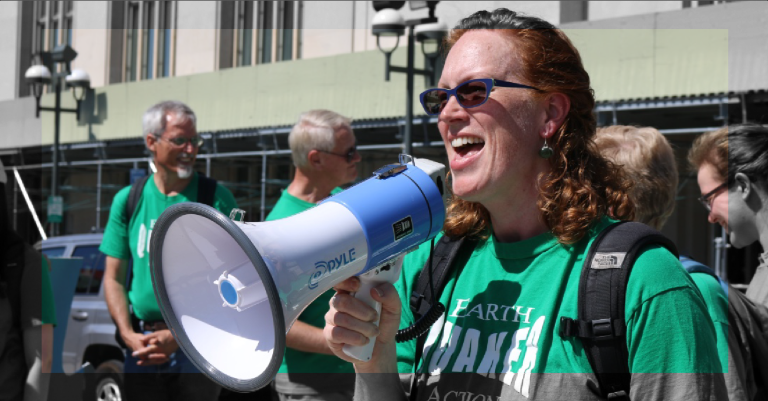
Betsy Torg is a volunteer and board member with Earth Quaker Action Team, or EQAT. They are a nonviolent direct action group that pressures major corporations to change their climate policies.
But Betsy hasn’t been a climate activist her whole life. In fact, her way into this work wasn’t driven by sheer moral willpower or scientific data. She got involved because of people.
Specifically, her child, who was protesting the Line 3 pipeline in Minnesota. You might remember another prominent Quaker activist, Eileen Flanagan, who joined us earlier this season to talk about this very protest. When Eileen told Betsy she was driving out to that protest camp, Betsy felt a sudden, spiritual pull to go with her.
Betsy Torg
There was a lot, all different kinds of actions happening out there. I participated in a green level action, which is where you’re not risking arrest, and that some of the indigenous people that live out there, and learned about the impact of this pipeline on the water, on the land, on their indigenous treaty rights, and it was very powerful, and I came back here, and then learned that Vanguard was a major investor in Enbridge, the company putting in the pipeline, and a major investor in Enbridge, who was also like financing the violence against activists. So I couldn’t.. it was kind of.. it was very much a spiritual calling to go out there and then coming back and learning that I was my own investments were financing the environmental violence and the activist violence where I just come from and so Earth Quaker Action Team had just launched this campaign and I felt called to get involved because I couldn’t conscience continue to hold my investments there knowing having having met people that were impacted, and seeing impact of what was going on.
Zack Jackson
When Betsy stood by that water and met the people whose lives were on the line, the illusion of separation shattered.
She realized that her bank account in Pennsylvania was physically connected to the suffering in Minnesota. That realization can easily lead to paralysis. But instead of letting the weight of the whole world crush her, Betsy leaned on a deeply rooted practice of discernment, focusing only on the piece of the work she was being called to hold.
Betsy Torg
One of the things that really keeps me going is someone when you’re really trying to sort out, like, what to do, and someone said they ask themselves the question, What is mine to do, and what would love have me do, and so when I reach the time, it’s just like overwhelming, where can I take action, it’s like, what is mine to do, like, what is right in front of me that I can tap into and take some sort of action that helps me a lot.
Zack Jackson
In any healthy ecosystem, different organisms play different roles. The same is true for the ecosystem of activism. We don’t all have to chain ourselves to a pipeline. There are Rebels, Advocates, Organizers, and Helpers.
For some Quakers, the work right in front of them is the quiet, restorative role of the Helper. Keith Runyan’s organization, Quaker Earthcare Witness, is piloting a new program this year, offering resources and encouragement for local meetings to recommit themselves to the places they call home.
Keith Runyan
And we’re going to be inviting Quaker meetings to make humble Earth Care Action something that’s part of our rhythm every year of our lives, that we come together as community, that we share food, that we, you know, break bread together, that we sink our fingers in the earth, that we do each in our own context forms of local spiritual action, where our hands are doing the prayer, and I think the smallest things are worth it. And that should be the root of however we respond to this moment is to recognize that the smallest things in your life are worth it.
how you treat the people around you, the way you show up and greet your garden in the morning, the way that you breathe, the way that you’re holding your loved ones, holding family, holding friends, creating community.
And it’s from that rootedness that I think the most powerful ministry emerges.
Zack Jackson
Sinking our fingers into the earth is a humble, necessary act of reconnection.
But sometimes, what love requires is the role of the Rebel. When Betsy Torg found her place with Earth Quaker Action Team, she learned that disruptive direct action isn’t just a political strategy. It can also be a profoundly spiritual, public witness. It is a way to physically live out the Quaker theology that God is in everyone and everything.
Betsy experienced the power of this communion when EQAT held a silent meeting for worship on the sidewalk in front of the house of Vanguard’s former CEO.
Betsy Torg
I don’t know how that sits with all Quakers. Maybe there are some that think like, oh, meaningful worship shouldn’t be used as an action, it’s a flashy tactic or something, but that I will say, in my experience with Earth Quaker action team, it is not that it is, it is truly worship, people are truly engaging in worship, and I know at that particular action in front of Buckley’s house it was super powerful, like I was feeling the presence of the folks that I had met in Minnesota who were fighting against the pipeline there. I felt the presence of the frontline community in Chester that I shared about, there were Quakers online with us, knowing that they were, that their spirits were gathering together with us, and there were Quakers all the way across the ocean in England that were in worship with us. So it just was really super powerful to know that it wasn’t just about us Quaker, it was about us there locally, but it was about something so much bigger than that.
Zack Jackson
When Betsy sat in silence on that pavement, she wasn’t just an individual protesting an investment firm. She was part of a global, living breath.
Whether it is a massive public protest, planting a community garden, or doing the quiet chores of daily life, the theological “why” remains exactly the same.
Christy Randazzo
I’d argue that, you know, it’s continuing to do the rituals that you might think are kind of waste of time, but you do anyway, you know, it’s continuously, you know, separating the recycling, even though you’re not entirely sure if it’s going to go, you know, in, you know, in a bin to China dumped in West Virginia. Who knows, you know? It’s doing things like actually still doing the composting, you know, you know it’s, it’s these small things, it’s not because I think these small things add up over time, but you know they do, you know, teaspoons of sand are still teaspoons, but I think it’s more of the fact that what, what Quaker religion, what the Quaker way is about is framing a way of living, a way of being, you know, a core, you know, where you are bound by thinking about others than yourself. So it is this idea that you’re going to, you know, keep doing things like taking the recycling out, because that builds in you a sense of you’re actually connected to someone other than yourself. It’s really, I mean, it seems small, but it’s these small things that accrue, you know, it’s a tiny thing, but it builds in you. A much greater thing, which is this sense of being connected with those around you, so it’s this ritual of continuously reminding yourself that you’re connected to those around you, and the more that you do that, the more others see that, the more that the work will be more successful, because you’re coming from the right place with it.
Zack Jackson
We do these things to remember.
We don’t take out the recycling or protest outside a corporate headquarters just to “save the earth” as if it is some separate, helpless, lifeless rock we happen to live on. We do them to cure our own spiritual isolation. We do them to remember that we aren’t standing alone on an empty stage. We are a living, breathing part of what Christy Randazzo calls, the divine ecosystem. And defending the dirt beneath our feet is just another way of coming home.
Zack Jackson
Thank you for listening and thank you to our guests, Christy Randazzo, Keith Runyan, and Betsy Torg, for sharing their wisdom and their witness.
For discussion questions, a transcript of today’s episode, and perhaps some quiet inspiration on what is yours to do, make sure you check out Quakerpodcast.com.
This episode was hosted, produced, and edited by me, Zack Jackson. Jon Watts wrote and produced the music.
Thee Quaker Podcast is a part of Thee Quaker Project. We are a nonprofit Quaker media organization dedicated to giving Quakerism a platform for the 21st Century.
If you feel led to support this ministry of storytelling and help us keep these conversations alive, please consider becoming a monthly supporter. You can go to Quakerpodcast.com and click “support” in the top right window. It takes less than five minutes, and we truly appreciate it.
Friends, as you move through the world today, may you notice the infinite connections between all living things. May you be firm and rooted, knowing your role in this divine ecosystem, nourishing and being nourished. May your acts of kindness be a reminder of this holy interdependence, and may your life be a prayer of peace.
And now, your daily Quaker message as read by Susan Majimbo.
Susan Majimbo
Josephine Moffett Benton. 1947. I believe that every piece of daily work can be done as a sacramental act. It is not too difficult to pray on one’s knees as the floor is scrubbed, ‘Wash me, O Lord, as I wash this floor…’ Awakening from sleep can be woven into a beginning prayer for the day, ‘As I stretch my body and limber my joints for the day’s tasks, thou O Lord, make my spirit supple and ready to accept whatever the day may bring…’ Prayers so brief can run through all the day’s activities. They can be simple, symbolic, spontaneous, based upon the needs and acts of the day.
Zack Jackson
To get Quaker wisdom in your inbox every day, go to Dailyquaker.com That’s Dailyquaker.com.
Hosted, produced, and edited by Zack Jackson.
Original music and sound design by Jon Watts (Listen to more of Jon’s music here.)
This season’s cover art is by Todd Drake
Supported by listeners like you (thank you!!)

Since humans have demonstrated the power to destroy the world this does point to a unique realationship between humans and the world. No other species has this power. We can choose to be cultivators or destroyers. At its core this is a moral choice. I think we must renew the understanding of the sacredness of nature to tame human avarice. I believe this has worked for non-western cultures.